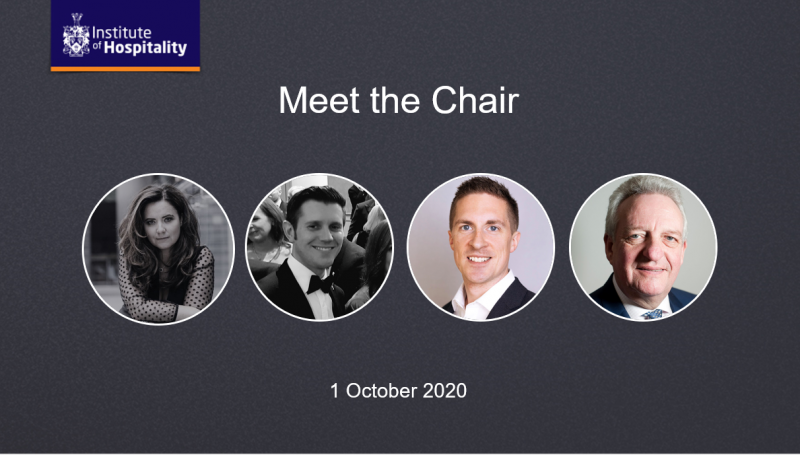
 Thanks to those of you who attended our webinar yesterday afternoon, where we outlined the future strategy for the Institute of Hospitality. As promised, here are responses to all the questions received from Members during the live recording.
Q1. What is your vision for the Institute going forward both in the UK & Overseas and what are the major steps to get there especially with the short and medium term challenges posed by Covid-19?
PD: During the pandemic direct face to face contact is a real challenge, so all our events are on hold, which is very frustrating. Before it started we had already switched almost all written communications to digital mainly via our APP IoH Connect. We have also continued to expand our webinar programme. This makes all of our resources available to any member anywhere in the world.
Our vision remains that branches or chapters are a valuable way of creating networks for professionals within an area. We also see a need for “Interest Groups” – online forums for members who share specific management disciplines, and see this activity being a key area of growth for us.
Our network of universities and hotel schools now spans every continent and creates a global cohort of students all of whom have access to our library and resources though our online knowledge centre.
As the world changes in the way it communicates, so do we.
We have also joined forces with other hospitality organisations to launch a new support hub for the industry. CareerScope provides easy to access content on everything from CV writing and career webinars to redundancy advice, financial support and health and wellbeing resources. It provides a vital service to retain those who have lost their jobs due to COVID-19
RR: Whereas Covid has brought immeasurable challenges, it has also made us look at how we communicate to our members, with an increased focus on the virtual platform. Our weekly ‘catch up with the Chief Exec’ and #IoHTogether programmes have been especially strong and our membership globally has responded well to these. Going forward we will build on these successes, with a focus on the inclusivity of our membership, irrespective of where they come from. Conversely, we invite our membership to tell us what they want from us and welcome constructive feedback.
Q2. As someone who became a student member at college in the late 1960’s and have been a member since and Fellow since 2004 – how do you envisage the Institute can raise its appeal to students and young entrants to our industry when many branches currently have relied on members, like me, who are past ‘retirement age’?
PD: We have created a small working party of younger MIH & FIH with the broad brief “What should IoH do to really support the next generation of hospitality professionals?” the broad questions are:-
RR: We are working actively to engage with younger members, and our recent board appointments support that. Our apprenticeship partner, HIT Training, has brought us over 5,000 new entry level members over the last year demonstrating that our brand has value for the rising talent our industry has produced; these promising results will be built upon as we move forward.
Q3. How do you think the Institute can best do to help branches increase membership and hold relevant events to engage their local Hospitality Professionals.
PD: Help them create a few “must attend” events and create local partnerships with both supply chain (for funding) and other industry associations.
RR: Moving forward we will be working to bring a degree of synergy to our branches, whilst supporting and encouraging them to engage with their own hospitality and educational stake holders. These partnerships are beneficial to both parties and allow us to grow our membership and develop our talent.
Q4. Can those centrally who are encouraging and negotiating ‘corporate’ memberships please encourage organisations to become active ‘Regional Partners’ to their branches – by being engaged in staging networks, improving their visible support for activities and networking and sometimes sponsoring our events and activities.
PD: In theory yes, although this depends on active and engaging branch events.
RR: Whereas I see the logic behind the question, we need to build the visibility and impact of our branches, aligned to shared objectives, to show that we add value to potential partners. Our corporate members are just that, members, and therefore we want to work with them to the fullest we are able verses the relationship being a transaction based supply and demand one.
Q5. I welcomed the appointment of Rachael Stevens MIH to the supervisory board as a step in the right direction to give the younger members of the institute representation at this level as well as the Institute being able to benefit from new perspectives and keeping us relevant in the increasingly changing ways of working. With the balance of our industry so much in the hands of the next generation and the innovation they can bring, what other plans do you have to increase engagement from those currently working there way up the leadership ladder?
PD: See Q1 above.
RR: See Q2 above. Having Rachael on the board was a “no-brainer”- glad that the board agreed with me! Rachael has a proven track record in driving branch engagement with her audience; developing those initiatives on a broader, better resourced, canvass will certainly support achieving what you are asking for here.
Q6. How do you see the relationship with UK Hospitality, Savoy Educational Trust, Springboard and Hospitality Action will develop. Is it possible this alliance will drive the agenda and force UK and Devolved Governments to attend a summit that establishes operating with risk management instead of the risk adverse policies that are slowly wrecking our sector. Ultimately we need a forum that can explain to Government how we can help ourselves and help the economy, people’s wellbeing etc?
PD: The relationship you name is already strong, with regular communication between us and a common view of our respective roles.
Regarding Government engagement this is the main mission for UKH. Regrettably despite media use of the word, hospitality is not recognised as an industry. We are a sub set of “Tourism”. This disregards the sizeable and socially critical not-for-profit sector. We engage with the Government through committees related to education and training, Springboard do the same plus employability areas. UKH engage with various departments, generally through DCMS.
RR: Completely agreeing with our Chief Executive, we have strong and well established relations here, deepened by our shared responses to Covid.
Q7. Regarding Brand Visibility: Can we display the IoH Logo on our personal professional website when we are a Member?
PD: Yes, membership logos are available to members (AIH, MIH, FIH).
Q8. We need to work harder at setting up regional branches – Manchester has tried but we need to renew our efforts here.
PD: Yes we do.
RR: See Q3, above. Couldn’t agree more, and the Board stands ready to assist.
Q9. How do you see the IoH role in the future of UK hospitality education within your strategies?
PD: Many are greatly concerned with the decline in UK Hospitality education at both FE & HE levels. As catering colleges are closed or downsized we depend increasingly on in house training to develop craft skills – particularly in culinary areas. The Apprentice scheme is our best hope which is why we strongly support it both through creating a level of membership for apprentices (because they are not necessarily associated with any seat of learning they have no easy access to text books or research materials, we provide that.
As Universities close their Hospitality Management programmes, or merge them into generic business degrees for economic reasons , and abandon “industrial experience” elements of the curriculum we see graduates with a good education in m management theory but little or no contextualised learning. We are working on creating a solution based on our Management Standards.
RR: Taking it a step back to school aged talent, the IoH has been nothing less than supportive of individual efforts to drive hospitality education. I cite their support of my own #InspiringHospitalityTalent initiatives as a proven example.
Q10. Love to discuss how IoH and ILTSA can work together.
PD: So would we. We see our role as promoting professionalism through lifelong learning, and are happy to work with organisations to support that element of their activity
Q11. How do you see the industry standard of Hospitality Assured (set up by IoH) in the future plan? There seems to be scope for increased publicity.
PD: It’s a couple of years since we licenced the standard to a new organisation managed by the senior assessors, whilst we still maintain the IP of the brand we are not directly involved in their marketing. We do sit on their board, and support their efforts in what is a difficult market. They are focussed on developing the brand and broadening its appeal, although as you can imagine they are currently in limbo due to COVID.
Be part of our well-respected network, get trusted advice and take a positive approach to your learning and development.
Your business card may take a moment to be generated. You can save your business card by right clicking -> save image as, or holding down on the image on your phone.