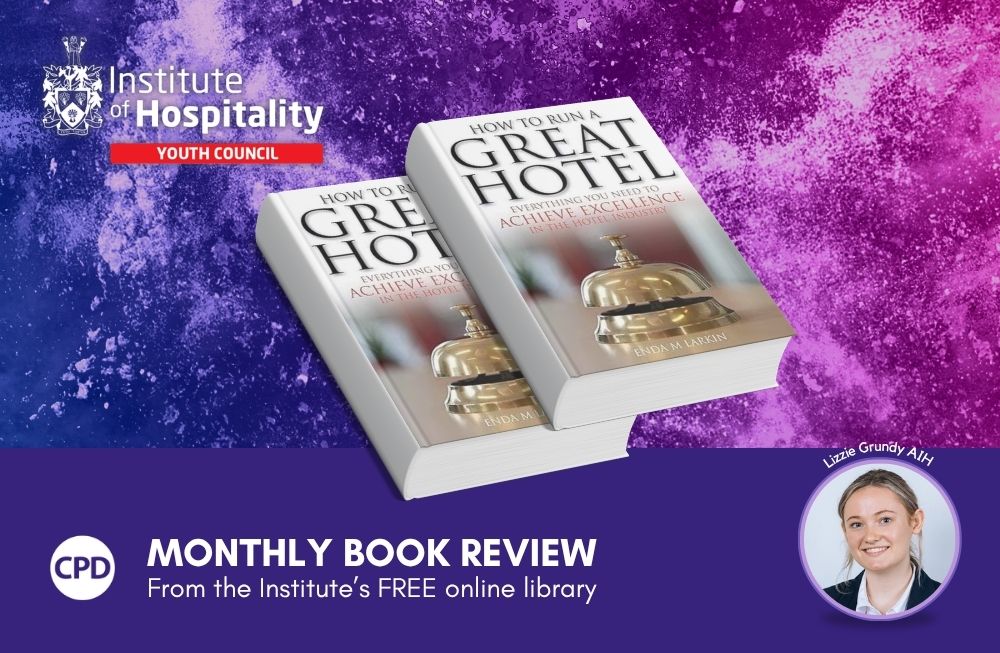
This month, IoH Youth Council Vice Chair, Lizzie Grundy AIH, reviews: ‘How to Run a Great Hotel: Everything you need to achieve excellence in the hotel industry,’ by Enda M Larkin.
Visit our FREE IoH Online Library
When selecting ‘How to Run a Great Hotel: Everything you need to achieve excellence in the hotel industry,’ by Enda M Larkin, I was hoping to read a step-by-step guide about how to solve all the challenges hotels face in the day-to-day operation so that in the future, if I step into a hotel management role, I can feel better equipped and prepared. However, realistically all day-to-day challenges hotels experience cannot be addressed in a book and are always evolving, between different hotels, facilities and locations.
What Larkin’s book does do is provide a clear guide for hotel managers for different areas of the business.
The first theme in Larkin’s book looks at the big picture, guiding how to set a vision and mission of the hotel, which in turn helps guide the creation of a strategy map to help set goals for the company to build success step by step. Without having an overall strategy to aid decision-making, it can be difficult to align the priorities of the business. This section would be helpful for hotel owners and general managers looking to evaluate their business and provide long-term direction in order to be successful.
Theme two looks at leadership, analysing the importance of leadership within a hotel and how effective leaders set standards, communicate expectations clearly and create a culture where staff feel motivated to perform well. This section highlights that leadership is not just about managing tasks, but about influencing people and creating consistency across the guest experience.
The main implementable tool from the book is the SERVICEPLUSONE framework, which helps identify how hotels can go beyond meeting basic guest expectations and instead add extra value through small but meaningful touches. This idea is especially useful because it encourages managers and teams to think practically about how service can become more memorable and customer-focused.
What I have taken away from the book is the breakdown of steps involved in implementing service improvements. Rather than presenting service as a vague concept, the book shows how it can be broken down into manageable actions that can be reviewed, measured, and improved over time.
Hotels have lots of moving parts, and trying to get each part right can be a challenging task. In the tools and resources section of this book, there is a breakdown of service steps by department, which can be used as a preliminary checklist to measure a department’s performance and ensure its key functions are being executed.
The end of the book provides useful suggested structures of key management functions such as interviewing, appraisals and meetings, which can be used as a sensor check for experienced managers who want to refresh their processes or provide guidance for new managers.
Overall Larkin’s book provides a real insight into hotel management whether it be for up and coming managers looking for guidance in what is a complex and challenging role, or for managers already established in their roles, who may be at the top of their game to use as a reminder about how simple yet effective refinement of our people skills, for both employee and guest facing roles, are having a great impact on culture and performance.
I will be keeping this book close to me as I progress through my career to refer back to when I need guidance in times of overwhelm or frustration.
This review and rating are the opinion of the reviewer.
5 stars = Exceptional not to be missed | 4.5 stars = Essential read | 4 stars =Very good | 3 stars = Good | 2 stars = Poor | 1 star = Very poor
This book falls under the Business and Leadership pillars of the IoH’s Five Pillars of Learning, an approach to continuing professional development based on the five core areas of hospitality management.
Record your CPD Hours: This book forms part of a member’s CPD hours. You can log your CPD hours here.
Be part of our well-respected network, get trusted advice and take a positive approach to your learning and development.
Your business card may take a moment to be generated. You can save your business card by right clicking -> save image as, or holding down on the image on your phone.