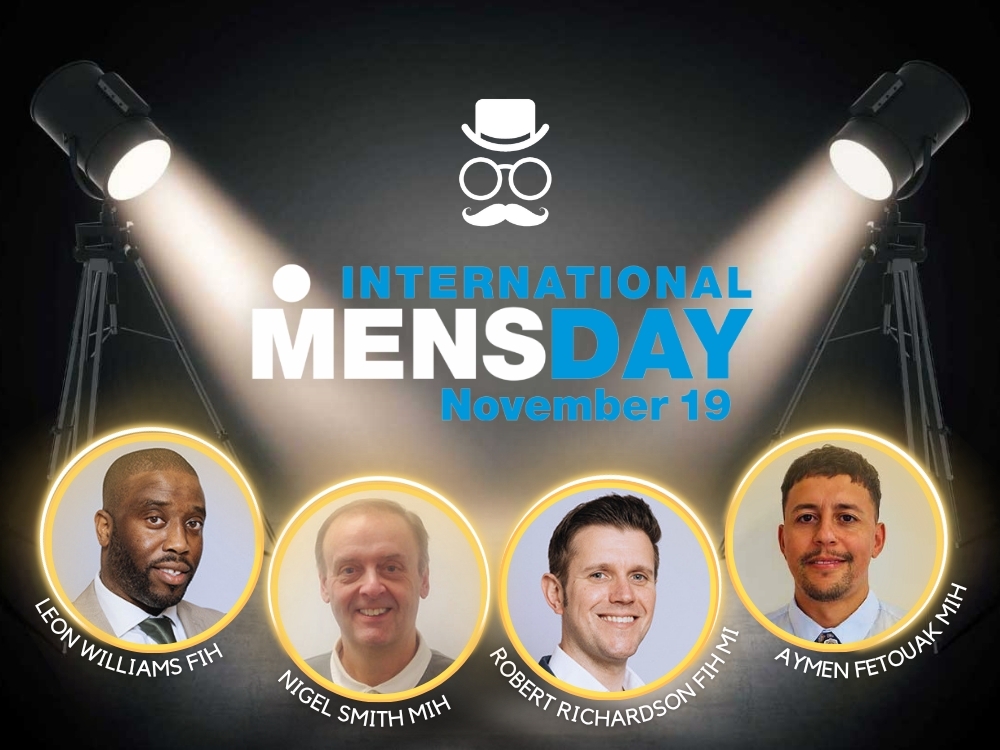
In a slight change to our usual spotlight style, the session resulted in an honest conversation. Joining Sonja and Francesca were: IoH CEO Robert Richardson FIH MI Hon DLitt, our Head of Finance Leon Williams FIH, our Head of Professional Development Aymen Fetouak MIH and our Membership Administrator Nigel Smith MIH.
Francesca: Thank you to the four of you for agreeing to speak to us!
We wanted to have a conversation with some of the men in our IoH team for International Men’s Day, focusing on men’s wellbeing and mental health.
Leon: There are a few people who spring to mind, but I have to say, without a doubt, it’s my dad, who passed away 10 years ago. He was amazing. He set an example for my siblings and me just by the way he was and how he lived. He was definitely a man of the people and was there for all of us. Everyone just loved him. Our house was filled with a community who would come to get advice from him.
This kind of example gets passed down, as one of my cousins and one of my best friends took me under their wing when I was younger because they’d been set this example by my father. So the lineage gets passed down.
Francesca: Amazing… If I may, Leon, I can see these qualities in you, so it’s clearly been passed down to you too.
Sonja: I’m curious as to whether you ever looked at other people’s fathers and benchmarked them against your own?
Leon: With four older brothers, I’m quite used to being the youngest around older men. I think when I was younger, I was definitely more enamoured by men with more bravado and confidence, maybe slightly flashier, with nice jewellery. But as I grew older, I realised I should strive for the person who quietly makes a difference, like my father.
There’s a saying in Jamaica, “empty barrel makes the most noise”, meaning the loudest person in the room is usually not the person with the most substance, which really rings true for me.
Sonja: That’s fantastic, Leon, thank you… How about yourself, Robert?
Robert: I’m a bit different to Leon in that I didn’t grow up with the same close, large family unit. In fact, I was probably a bit of a disappointment to my dad when I trained as a chef, as he didn’t see it as a ‘proper career’. As such, I’m actually a big believer in ‘found family’.
I’ve always looked out for a good role model during my early career. Robin Sheppard, for example, who despite facing challenges, still built an empire, really impressed me.
We are now living in an age of social media and, therefore, many of us are role models to an extent. The more we put ourselves out there, the more people will see us and potentially be influenced by what we do. I myself make a conscious decision to steer away from religion or politics when I post, and I have a no-profanities rule. It’s important to try and be the best role model you can be when you’re putting yourself out there.
Franci: Great point! What about yourself, Nigel?
Nigel: Quite a few guys have influenced me over the years and pushed me in the right direction. In my first ever job, my manager was absolutely brilliant and taught me so much. I was only 18, and I always remember him and the advice he gave me.
Family-wise, one of my uncles was always there for me if I needed any help or advice, including financial advice! I’m a huge cricketer, as the IoH team know, and many of the cricket team have made a positive difference to my life. But like Leon, I have to say, first and foremost, it’s my dad. I didn’t have any siblings, so I got 100% of his attention growing up, and he supported me and advised me whenever I needed him. From driving me to cricket when my car wouldn’t start, to taking time to answer questions on life in general, he was always there for me, giving me solid advice.
Sonja: That’s lovely, Nigel… And what about yourself, Aymen?
Aymen: I’ve been fortunate enough to cross paths with many remarkable men who have left a mark and taught me different things. I too, like yourselves, Leon and Nigel, have been inspired by my dad. Growing up, he was in the army, serving as a lieutenant, and I guess he had that kind of personality, giving an air of authority. Growing up and observing that inspired me.
These days, I lean closer towards my spiritual role model, Jesus Christ, who is an example of humility, compassion and leadership that I aspire to.
Nigel: I’ll kick off this time! I think it’s very important for somebody at this stage of my life to help others who are struggling. The best example I can give, actually, is from about 18 months ago. One of the guys in my cricket team runs his own small business. He’s a young chap in his mid-20s and was really getting down on himself with the way things were going, with the cost of stuff, the taxation, the business rates coming in. It was all just coming on top of him.
I could see how stressed he was, so one day I sat him down and we discussed it for about three hours. Just talking about everything that was bothering him and calming him down. It’s very much like Robert said about stress. I mean, that is obviously 80% of the problem with the young guys out there who are looking to really push on, and that is stopping them. It builds up in their head and that’s it.
But we sat down and had a good chat. Fast forward a few months, and he’d planned out his small business, what he was going to do. He got things in place and made a plan. He was a completely different person, and I’m proud of the small contribution I made.
Francesca: That’s lovely, Nigel, well done… What about yourself, Aymen?
Aymen: It’s incredibly important to me… particularly as a father. Children don’t learn by remembering things you say to them; they learn by watching your example.
Sonja: Absolutely!
Aymen: Definitely… How we treat people and our response to difficult situations, how we handle our own mistakes, etc. In terms of leadership, I think as somebody who has worked with younger professionals and a mix of different ages, you learn to listen and recognise potential. And you try to lead by example.
Personally, as I raise my own son, I want to demonstrate that being a good man isn’t about being a strong person; it’s about being kind, compassionate and dependable.
As I mentioned earlier, my early memory of my own father as a role model was one of authority. I’m not saying my dad was unkind, but he was of the generation where he wouldn’t show his feelings, so I took the emotional side of things from my mum. So I try and give my son a balance of both.
Sonja: That’s quite interesting, actually, because we often look to our parents as role models, but there can also be elements of their parenting style that you may think, “Actually, that’s not quite how I’m going to do it.” As times change and parenting styles change. What about yourself, Robert?
Robert: It’s so very important. I’ve seen the dark side of this. I had a stalker for eight years because of something they saw in me that I wasn’t putting out there. So I’m very aware that it’s important.
I had an experience recently with a young IoH member who DM’d me as he was in casualty and had no one to talk to. I talked to him for two hours via social messenger until his uncle turned up to look after him. I see it as a privilege that he felt he could reach out to me.
Sonja: Brilliant… Leon, what about yourself? I get the feeling you’re probably a role model to quite a lot of family members!
Leon: I probably would say yes, I am… although I do try and be modest about it, to be honest. But yes, going back to what I said earlier about my dad, I’ve tried to continue in his path but in my own way.
We are a big family, and myself and my siblings all have kids, who have gone on to have kids of their own. When my own daughter was growing up, there was a batch of her cousins, all a similar age, who grew up together. I’ve stayed close to them and maintained a great relationship, and as we’re talking about men in particular, my nephews would often come to me for advice. I think this makes me a better person… Sometimes I’d look at them and think, “Wow, you actually look up to me”, and it makes me feel I can’t let them down.
I don’t know what it’s like for yourselves, Robert, Aymen and Nigel, but sometimes when you’ve got that responsibility of other people looking up to you, it could feel like a burden, because, as the saying goes, “Who does a go-to person go to?” However, for me, I see it as such an honour.
I’ve got one particular nephew who, for various reasons, had to grow up way too early, and I’ve got such a soft spot for him because of this. He’s since turned his life around and confidently comes to me to talk about anything. I feel he sees me as a second dad, and it means so much. And as I said, it just makes me want to be the best that I can be.
Robert: I think there is a little bit of a double standard around men’s mental health and stress levels. We all know the phrase “man up”. There’s an expectation of men, to be very honest, to be held to a higher account than other people in society, which is wrong.
And I think in society, there is still an elephant in the room around men’s mental health and the standard to which men are held. I think we’re only a generation away. I know my dad would never admit to being down or being depressed or being stressed because that’s not the done thing, and we’re only really coming into a generation where we’re encouraged to talk about it and find ways to manage it.
Sonja: Leon, what are your thoughts?
Leon: Mental health is high on the agenda for me. I practise meditation… It’s just a moment to check in with your mind and body. I see it as really important to stop and actually be aware of how you’re feeling, and do a bit of centring.
Another bit of wellbeing I practise is to try and make sure I exercise regularly. It doesn’t always go to plan… I admit, before this month, I’d not been to the gym since August! I was amazed at how much my fitness had deteriorated. But anyway, the plan is to resume this and just carry on.
So when I’m on point and I’m meditating, I’m exercising. And then, more importantly, to Robert’s point, I’ve got a really good network of support. If things happen, I’ve got people I can talk to.
Sonja: It sounds like in your family you really do talk to each other, like men talk to men about feelings. Which is fantastic because that’s not always the case.
Robert: If I could give my younger self one piece of advice, it would be to stop being quite so hard on yourself. You don’t have to have all the answers, prove your worth to everyone, or carry every burden on your own.
I think, particularly as men, we spend far too much time believing that strength means coping with everything, without admitting when we’re struggling.
But real strength is recognising that we’re human, accepting that we won’t always get everything right, and having the courage to ask for help.
Above all, I’d remind myself that your worth isn’t measured by what you achieve, but by who you are and the difference you make to others.
Francesca: Great advice… What about you, Leon?
Leon: I would tell my younger self to be more intentional about your plans and choices. I heard a saying a few years back, “Big-time plans, but small-time processes”, meaning that you can have all the best plans and ideas, but if the processes to carry those out are just not great, it’s not going to happen the way you want it to.
So definitely, I’d tell myself that I need better processes to carry out my hopes and dreams.
Nigel: I would probably say something along the lines of listening to your body. Really recognise the physical and mental signals of stress or fatigue, whatever it is, before it turns into something like exhaustion.
Looking back, if I had given myself the chance to slow down a bit and look at things in a different light and say, well, let’s pace it out a bit better, you’d be OK.
Sonja: That’s a great bit of advice to yourself; now we just need a time machine! What about you, Aymen?
Aymen: Like Robert, I think the first thing I’d say to young me is to stop being so hard on yourself. And then I’d probably tell myself to get rid of the fear of being judged. Everything that I did, including what I wore, I worried about what people thought. The fear of being judged does affect you and your mental well-being.
And then the third thing is that nothing is impossible. I know that sounds very cliché, but we are fortunate enough to live in a country where the opportunities are there if you put in the effort.
Sonja: Absolutely. We’ve got free education!
Aymen: We’ve got so many opportunities compared to other nations, and we don’t want to get political here, but if you want to become a carpenter, you can go and do an apprenticeship. You want to become a footballer? If you’re good enough, you will make it to the highest level. All you need to do is keep at it, be consistent and work hard, because we’re fortunate enough to live in a country where those opportunities are available.
Lastly, I’d probably tell my younger self that it’s perfectly acceptable not to have everything figured out. I think I believe in it more now than I did back then.
And to Nigel’s point, physical health matters so much because before you know it, when you’re a 16-year-old running around the field playing in every position in football, before you know it, you’re aching to get out of bed. So listen to your body. Listen to your health. Listen to your mind.
Sonja: Look after your knees.
Aymen: Look after your knees, and your needs! And make time. Make time for people that are around you, people that you love, and look after your body. Don’t neglect your emotional wellbeing.
Francesca: Very well said, Aymen… Nigel, lastly, we’ll come to you with the same question!
Nigel: Aymen’s comments about young boys and the stresses that they have and everything were spot on. That was actually one of the main things I was going to say. With all the various mental health challenges you can have; depression, anxiety, perhaps even PTSD, men are still, in my opinion, reluctant to go and seek help, just because they feel some kind of weakness. They feel that they need to be seen to be strong and try and get through it all.
But there are many, many stages where that doesn’t apply. As I said earlier with my guy from my cricket club, you have to seek help, or be advised to seek help, as soon as there’s a change in character.
Sonja: Would you follow that advice yourself, do you think? So if you were struggling, would you go to a male friend and talk to them?
Nigel: There are many times over the years when I’ve had chats with friends or colleagues to say I’m struggling and ask for advice.
I suppose I’ve been really lucky in all the jobs that I’ve had, that I’ve had people in those positions who knew what to say, or to advise, or who to go and see.
Sonja: Thank you all for a fantastic conversation about men’s mental health! Both Francesca and I are so grateful for your honesty and for taking the time to talk to us.
International Men’s Day takes place on 19 November.
For more information, visit internationalmensday.com.
Be part of our well-respected network, get trusted advice and take a positive approach to your learning and development.
Your business card may take a moment to be generated. You can save your business card by right clicking -> save image as, or holding down on the image on your phone.