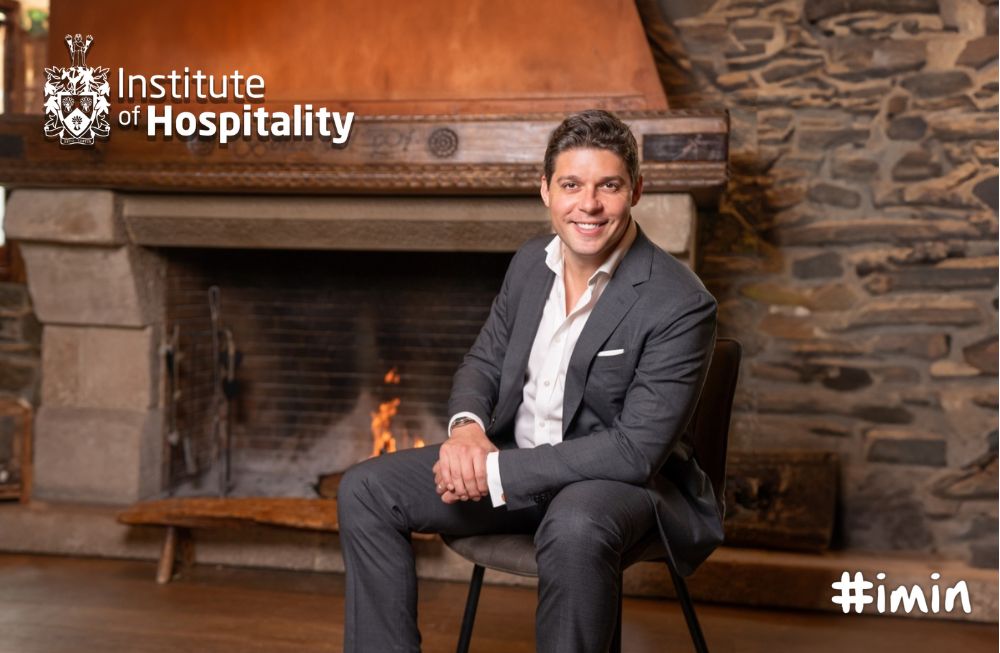
New York was my dream destination for a first job in hospitality, even though at the time (this was the mid-2000s) Dubai was seen as THE place to go and many of my classmates were heading there.
I grew up in Lebanon and had also lived for a while in Saudi Arabia, so the Middle East was familiar territory. I wanted to take myself out of my comfort zone and try something really challenging, and I guess you could say that is one of the attributes it’s useful to have if you are ambitious to set out on a global career.
Another is, of course, to choose hospitality as your career path, since it happens to be the most geographically diverse of all industries. There’s a hotel in every town, in every country. If you want to see the world while you work, you can’t choose better than a hospitality career.
The benefits of an international career
The year-and-a-half I spent in New York was the first staging point of a career that’s so far taken me to eight different countries, leading up to my present home in Andorra, from where I’m running the consultancy Thinking Luxury with my wife Miriam Palà and my co-founder (and Glion alumna) Stéphanie Steinbrecht-Aleix.
So, what benefits and advantages do I feel I’ve gained from all this international exposure? Thinking back to when I started out in New York, I’d say the biggest benefit was that it made me grow up fast and become a man. Why? Because I’d never paid taxes before. I had to get my Social Security number. I had to find a place to rent and put a down payment on it. And of course it put me in a different time zone to my family, so I had to become more independent.
I often joke that my time working in New York was like doing Master’s degrees back-to-back; on leadership, management, absolutely everything. Although at that time I spoke English fluently, it wasn’t my first language, French was. So being immersed in an English-speaking culture definitely helped me perfect my English, which is good, since I teach Glion students exclusively in that language today.
Working in New York scratched a lifelong itch, but when the time came to move on I wanted totally different surroundings in which to continue building my global career. I decided to try to get a job on a resort island – but one where I didn’t speak the language, because I was still very much in a personal growth mindset.
This ambition took me to the island of Crete, and a new resort hotel opening that a friend of mine was involved with.
This new experience could not have been more different to my time in New York – and not just because of the location and typical clientele. The hotel was very much a family business, with a number of relatives working across the property. That created a totally different dynamic for a 24-year-old looking to build a management role, and this taught me a huge amount about leadership styles, in particular how to soften my approach. I also learned how to gain the respect of my reports by rolling up my sleeves and doing the jobs I required of them.
I have no doubt that being in such diverse work environments can enhance our skills in leadership and problem-solving, as well as cross-cultural communication; and in a cultural melting pot like hospitality it becomes essential to go through this learning experience if you’re ambitious to reach senior leadership positions such as department head or general manager.
From a purely professional point of view, having international experience is definitely seen as a plus by employers, giving you potential to get in prime position for roles that will increase your earning potential and/or offer enhanced job satisfaction.
The challenges of a global career
While I would always endorse the choice of an international career, it would be wrong not to acknowledge the challenges you’ll face along the way.
When I’m talking to Glion students, my message is always “do it early, before you acquire too much baggage”. By that I mean family and financial commitments. Heading off to a job in Bora Bora is an amazing adventure when you are 25 and single; less so when you are 45 with a partner and two kids, a mortgage, and a sick parent to look after.
It perhaps goes without saying, but of course you must also be culturally open-minded to make an international assignment work. This was perhaps even more the case in the days before the internet, whereas now you can become immersed in a culture online before you experience it in person. But even today you must leave your prejudices and preconceptions at the airport if you want to experience the best of your new environment.
Glion students are lucky in that cross-cultural fluency becomes second nature as they mix on campus with around 100 nationalities. With a wide choice of internship destinations it gives them a head start in developing a strong cultural understanding.
But probably the biggest challenge of a global career is what to do if a job doesn’t work out? This tends to hit harder than when changing jobs in the same city or country, because to relocate you’ve inevitably invested much more time, effort and potentially money to make it happen.
This is exactly what happened to me after leaving the resort in Crete, and while I don’t have the perfect answer as to what to do, I can at least relate from my own experience.
I moved to a hotel in London, taking a lower position than I was qualified for on the promise that I would be promoted when a colleague relocated to Abu Dhabi. But the whole thing was a disaster – nothing worked, the leadership was bad, and the working practices were archaic.
In my head I was like ‘why am I accepting this?’, but I still had a bit of that New York mentality which was just to push it for one more month, one more month, in the hope things would work out.
So my advice, if you like, would be to give it your best shot, but to recognise when a job is simply not for you, and act quickly and decisively. For me that came after four months – I left the business and never looked back.
Maintaining a healthy work-life balance along the way
Although not exclusive to international careers, the issue of work-life balance is sure to be one you’ll face if that is your desired pathway.
Hospitality is hard work in often unsocial hours; that much is common knowledge. As such, you have to be careful not to become too deeply immersed in your job to the detriment of all life outside it. And this is especially true when working in a new country, where you’ll often be away from family and your friendship network.
Although I really enjoyed the role, I experienced this to a degree when working at a hotel in London, where I was Assistant Front Office Manager. I learned a huge amount there, particularly when I was on the night shift, because in a hotel everything that happens in the middle of the night is not ‘normal’.
But my work-life balance became poor at the same time, because I couldn’t stop working. I even had calls transferred to my personal mobile!
In your early career there’s a certain trade-off between working too hard and the experience you gain from doing so. We all have it in us to do this in our 20s, but again the secret is knowing when to say ‘enough’ and move on.
For me, this meant leaving the operational front line and taking an office-based role with the Ritz-Carlton hotel in Barcelona. That was an amazing experience… I learned another language, Spanish, and I also learned a lot about time management, as well as the area I was specialising in, namely events. And I also met my wife there, so it was pretty much a perfect posting.
Stanislas Helou is a Visiting Lecturer at the Faculty in Luxury Brand Management / Ultra-Luxury Travel Experiences at Glion Institute of Higher Education
Be part of our well-respected network, get trusted advice and take a positive approach to your learning and development.
Your business card may take a moment to be generated. You can save your business card by right clicking -> save image as, or holding down on the image on your phone.