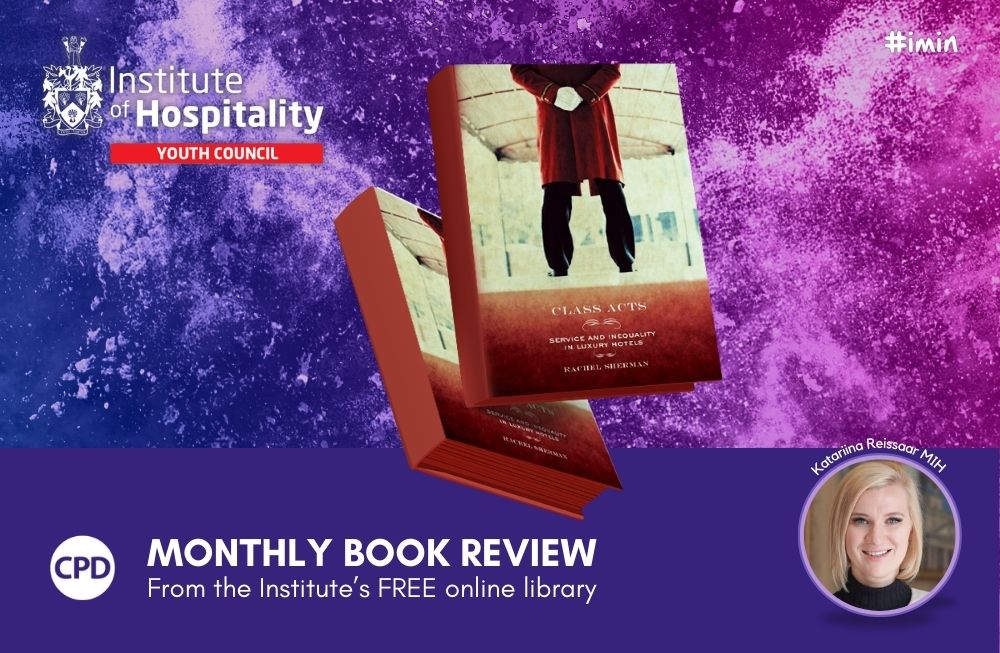
This month, the Institute’s Youth Council Chair, Katariina Reissaar MIH reviews: ‘Service and Inequality in Luxury Hotels’ by Rachel Sherman.
Visit our FREE IoH Online Library
Rachel Sherman’s ‘Service and Inequality in Luxury Hotels’ presents a fascinating, in-depth analysis of the behind-the-scenes undercurrents in high-end hospitality establishments. Through meticulous research and first-hand interviews with hotel staff and guests, Sherman unpacks the often-overlooked intersections of service, privilege and inequality.
This eye-opening book provides crucial insights into how luxury service is performed and experienced while raising important questions about the social imbalance in hospitality.
Sherman’s approach is ethnographic, focusing on workers in New York City’s luxury hotels. She explores the subtle power dynamics that shape the interactions between staff and guests, shedding light on the emotional labour involved in providing seamless service. One of the book’s key strengths is its humanising portrayal of employees from housekeepers to concierges, who navigate the fine line between servitude and professionalism.
Sherman’s findings are particularly compelling regarding customer experience. The book delves into how luxury hotels create an illusion of effortlessness in service, masking the effort and coordination required to fulfil guest expectations. This speaks to the third pillar of the Institute of Hospitality’s learning framework, reminding us that excellence in customer experience often depends on an invisible workforce whose contributions are too frequently undervalued.
What makes ‘Service and Inequality in Luxury Hotels’ especially pertinent for hospitality professionals is its focus on the emotional demands placed on workers, who must manage their feelings to accommodate the varied expectations of wealthy, often demanding guests while maintaining their dignity and composure. This exploration provides valuable insights into how luxury service shapes and is shaped by the interactions between staff and clientele.
The book also touches on the broader societal implications of luxury service, particularly the class divide between those who provide it and those who receive it. Sherman critically examines how inequality is perpetuated in the luxury sector, raising ethical questions for hospitality leaders. This is particularly relevant for those of us seeking to build inclusive and equitable work environments, where staff feel valued regardless of their position.
While Sherman’s focus on inequality might seem disheartening, the book also offers a nuanced view of agency in the service industry, and workers often find ways to assert their autonomy, even within rigid structures of hierarchy and power. For readers in leadership positions, this serves as a reminder of the importance of fostering a supportive work culture that recognises the value of every team member.
In conclusion, ‘Service and Inequality in Luxury Hotels’ is a vital read for anyone in hospitality. Its insights into customer experience, emotional labour and imbalance are particularly useful for those looking to refine their understanding of service excellence. Sherman’s work not only enhances our appreciation for the complex nature of luxury hospitality but also challenges us to reflect on how we can create more principled and empathetic service environments.
This review and rating is the opinion of the reviewer.
5 stars = Exceptional not to be missed | 4.5 stars = Essential read | 4 stars =Very good | 3 stars = Good | 2 stars = Poor | 1 star = Very poor
Suitability: This book is suitable for any hospitality professional, at any level who wants to learn about customer service and refine their understanding of service excellence.
This book fits into the Customer/Guest pillar under the IoH’s Five Pillars of Learning, a new approach to CPD professional learning and development based on the five core areas of hospitality management.
Record your CPD Hours: This book forms part of a member’s CPD hours. You can log your CPD hours here.
Be part of our well-respected network, get trusted advice and take a positive approach to your learning and development.
Your business card may take a moment to be generated. You can save your business card by right clicking -> save image as, or holding down on the image on your phone.