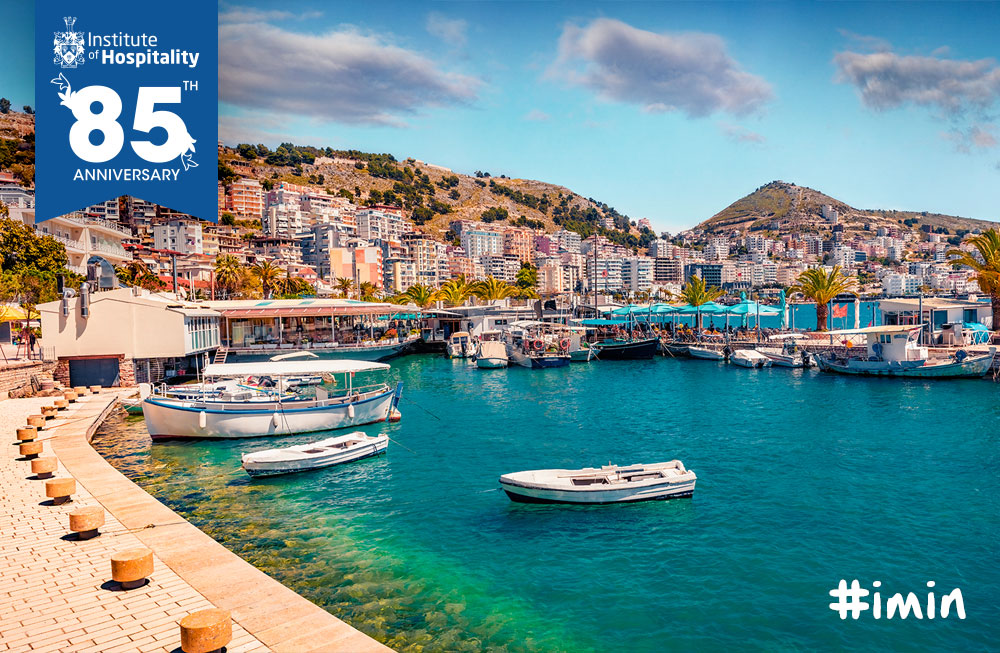
The Republic of Albania stretches nearly 300 miles along the Mediterranean coast on the Adriatic and Ionian Seas; it shares land borders with Montenegro, Kosovo, North Macedonia and Greece.
Travellers can admire mountain castles and beautiful landscapes; they can laze on beaches and learn about the history and traditions of the “country of eagles” – the eagle is the country’s national symbol. Ancient fortresses, majestic mosques and churches, and bunkers from the time of Enver Hoxha, ruler of Albania from 1944 to 1985, stand next to modern buildings, hotels and restaurants.
Albania’s prosperity has been, and is, tied to the development of tourism, which recently produced a direct contribution to GDP of up to 8.7%. But add in multiplier effects from indirect sources and that figure leaps to more than 20% of GDP, making the sector one of the key growth drivers. Albanian data statistics agency INSTAT reported that 377,211 international travellers came to Albania in January 2023, compared to
194,237 in 2022, an increase of 94.2%. The number of domestic tourists also increased from 259,835 in January 2022 to 456,239 in 2023. In 2022, some 7.5 million people visited Albania, an increase of more than 32% against 2021.
This has raised the country’s profile; it has appeared in glossy international travel magazines, attracted music festivals and spawned hundreds of glowing reviews from Instagram and YouTube influencers.
Closed off from the world for almost 50 years, Albania has been working hard to bring tourism to its many attractions. But while people flock to the Balkan country, Albanians are leaving in droves. Since the fall of communism in 1992, some 1.4 million people have left, 700,000, in the past decade and as a result, cafés, restaurants and hotels are struggling to find employees.
Tourism and hospitality are having a golden year of recovery but more needs to be done to stabilise the sectors, says Alma Zhilla PhD from the Faculty of Economic Tourism, Fan S. Noli University Of businesses surveyed in the UN Development Programme (UNDP) report Tourism and Hospitality in Albania 2022, 56% believed the lack of labour to be the main issue hampering Albania’s expansion, while 26% saw low skills as the problem.
Some three quarters of those polled said they had to make do with staff shortages at the peak of the tourist season when they would typically have increased employee numbers by 35%, financial publication Monitor reported.
The findings come after the World Tourism Organisation stated Albania had the “best post-pandemic recoveries in the industry” in 2022, compared to 2019, with arrivals and revenue from tourism largely surpassing pre-Covid levels.
Of the nationalities the most likely to visit Albania, Spanish and then British tourists headed the list, knocking Poles and other Eastern Europeans off the top two slots.
Competition in the hospitality sector has intensified significantly. Albanian hotels and other accommodation facilities are increasingly present on global booking platforms such as Booking.com and Airbnb. While this has boosted tourism in Albania, it has also created a fertile ground for the informal sector, and it is estimated that one third of accommodation units on Booking.com are not registered/licensed.
In addition, the number of rental apartments on Airbnb has increased by more than 70% since 2019. The homesharing segment operating through this site is said to generate annual revenues of €20 million; accommodation units saw the highest tourist numbers in 2022, relying mostly on non-residents, except in the south east of the country, where it largely depends on the domestic market.
Finding and retaining employees and unqualified people are cited as the biggest obstacles facing the sector, although the majority of hotels names rising prices, global challenges, unfair competition and poor infrastructure as the main problems. And more than half the hotels stated that the government should promote Albanian tourism worldwide, removing the need for financial incentives.
There are two major factors negatively impacting on hospitality:
However, Albanian hospitality businesses are still feeling their way in the new realm of digitisation, and they will need government support to engage with the transformation.
Also important is the involvement of local communities in decision-making. Promoting socio-economic equity and enabling a fair distribution of the benefits of tourism such as stable employment, income-earning opportunities and better services for host communities will be crucial to the growth of the sector.
Finally, the pandemic and other recent crises brutally revealed the vulnerability of the industry; and tourism’s importance to the Albanian economy means strategies to build a resilient, inclusive and sustainable sector are vital.So, all actors in the ecosystem should be designing and implementing tourism models that reflect social, environmental and economic matters.
But for now, Albania’s tourism sector is going from strength to strength, even in the low season. As the almost doubling of international arrivals in January compared to the same month in 2022 shows, it has been a good start to the year.
You can find article and many more in the current issue of Institute of Hospitality Magazine… a member benefit.
Be part of our well-respected network, get trusted advice and take a positive approach to your learning and development.
Your business card may take a moment to be generated. You can save your business card by right clicking -> save image as, or holding down on the image on your phone.