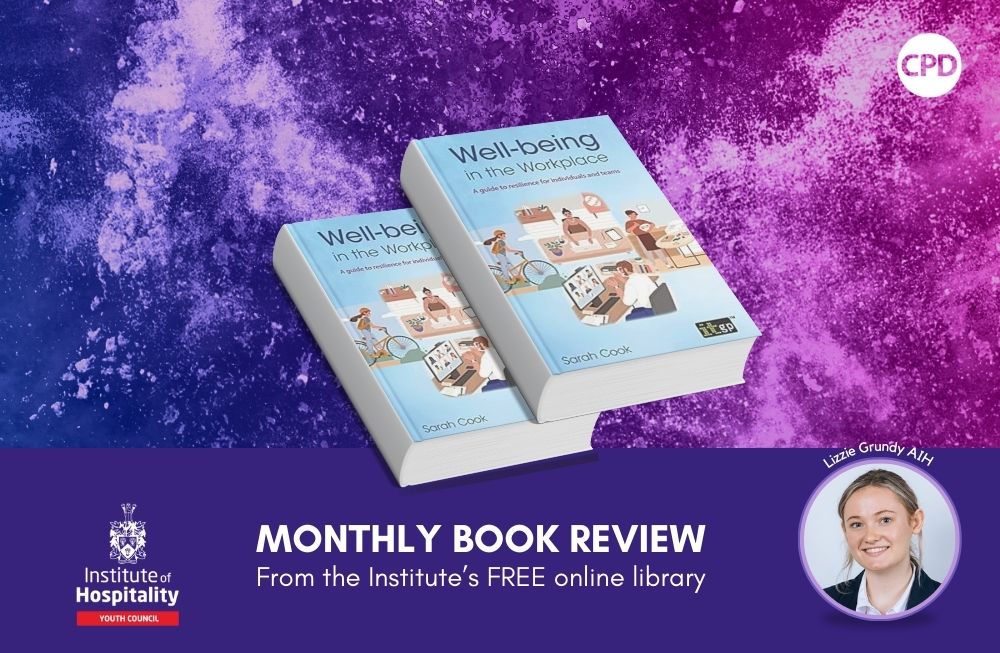
This month, IoH Youth Council Vice Chair, Lizzie Grundy AIH, reviews ‘Well-being in the work place : A guide to resilience for individuals and teams’ by Sarah Cook.
Visit our FREE IoH Online Library
Sarah Cook explores a post- Covid pandemic workforce and addresses the importance of building resilience to cope with change and adversity. As we start 2026, a time often associated with self-improvement, new habits and fresh starts, it’s important that we consider all elements of self-care in order to ensure we can sustain the changes we make.
From the outset, the tone of the book is practical and action-oriented. It provides real-life examples and tools for self-assessment, allowing readers to identify relevant tips from the book that can be implemented to improve resilience.
The term ‘Burnout’ is a phrase we hear more commonly in open conversation around mental health. Cook lists several behaviours and side effects associated with burnout, which can help readers recognise symptoms. These can result from when pressure turns to stress due to a lack of resilience, and burnout can be difficult to recognise and admit in high-pressure environments such as the hospitality industry. Therefore, using this guide can help identify when stress is taking over.
One of the book’s key features is the tool in chapter 3: Assessing your own levels of resilience. It is built up of simplistic statements with agree to disagree answers across the four energies: physical, emotional, mental and social well-being. Having taken the resilience assessment myself and recording results of low personal resilience, I’ve been able to reflect on my own mindset and identify areas where I can build my resilience.
Chapters 4 through 7 focus on tips for physical, emotional, mental and social well-being, from the importance of quality sleep and healthy eating to the power of the mind and taking control. While also recognising that seeking professional help is also important when required.
Overall, this accessible and easy-to-follow framework, while seemingly basic, is a good tool for reflection and assessment for professionals working at all levels. Particularly for managers, this book is a helpful tool to build team resilience, reflect on their own energies and how this framework can radiate throughout the team.
While Cook’s approach is not an immediate fix to low resilience, it’s a great way to simplify the contributors to stress and burnout due to low reliance, with applicable and simple tools to help teams improve well-being and self-care at work. Within a team, it starts with putting well-being on the team agenda and requires a conscious effort from management to implement two-way communication and the power of recognition.
I would encourage everyone to reflect on their resilience, especially managers, to build their self-awareness around their teams’ energies in order to support a sustainable workforce.
While the context of the book focuses on the increase in remote working and how to help team members to adapt to the way of working, the tools and assessments can be used in all workforces, including operational front-line hospitality workers.
This review and rating are the opinion of the reviewer.
5 stars = Exceptional not to be missed | 4.5 stars = Essential read | 4 stars =Very good | 3 stars = Good | 2 stars = Poor | 1 star = Very poor
This book fits into the Team and Self-Care pillars under the IoH’s Five Pillars of Learning, an approach to continuing professional development based on the five core areas of hospitality management.
Record your CPD Hours: This book forms part of a member’s CPD hours. You can log your CPD hours here.
Be part of our well-respected network, get trusted advice and take a positive approach to your learning and development.
Your business card may take a moment to be generated. You can save your business card by right clicking -> save image as, or holding down on the image on your phone.