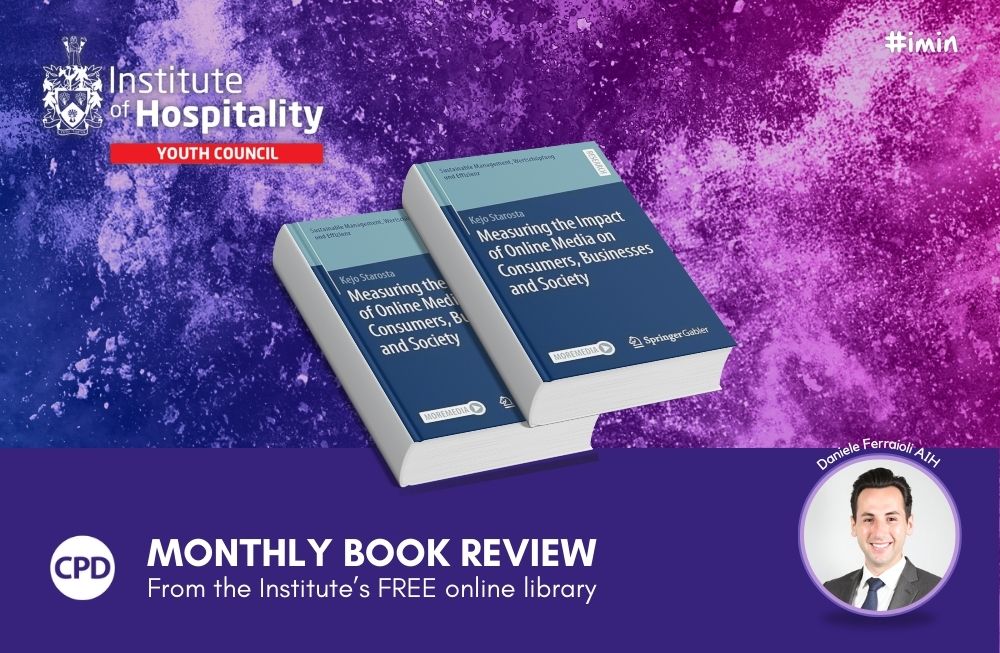
IoH Youth Council member, Daniele Ferraioli AIH, reviews Measuring the Impact of Online Media on Consumers, Businesses and Society, written by Kejo Starosta.
Visit our FREE IoH Online Library
In an age where digital media shapes nearly every aspect of our lives, Measuring the Impact of Online Media on Consumers, Businesses and Society written by Kejo Starosta is both timely and relevant. The book deep dives into how sentiment expressed online, whether through news articles, social media posts, or blogs, can influence consumer behaviour, business performance, and even larger societal trends.
What makes this book stand out is its focus on sentiment analysis: a method of analysing the emotional tone in media content. Starosta uses this technique not only to measure public mood but also to predict real-world outcomes like tourism demand and economic confidence. One key learning for me was how real-time analysis of online content can sometimes be more accurate than traditional surveys or reports. In a world that moves quickly, having that immediate insight is incredibly valuable.
A particularly fascinating section looked at how media sentiment affects tourism. Through various case studies, Starosta shows how negative media coverage, for example, during health scares or political crises, can lead to sharp declines in tourist visits. It’s a concrete example of how perception can directly influence economic outcomes. This approach doesn’t just apply to tourism either: it has wide implications for retail, finance, public health, and more.
Another highlight was the cross-country comparison of media sentiment. Starosta digs into how media in different nations report on the same topics, often with starkly different emotional tones. These differences are not just academic, they affect international business, politics, and consumer trust. The book also explores how media bias and “filter bubbles”, where people are only exposed to views they already agree with, can distort public perception. This has never felt more relevant, especially in an age of misinformation and algorithm-driven content.
The book is quite data-heavy at times, and while the charts and models are informative, it might feel overwhelming for readers unfamiliar with data analysis. That said, the language remains accessible, and key concepts are well explained. Starosta does a good job connecting technical analysis to real-world examples.
Key Takeaways
Conclusion
I would recommend this book to anyone interested in media, marketing, or analytics. It provides a fresh perspective on how online conversations impact real-world decisions and outcomes. While it’s especially useful for those in data-driven roles, it’s written clearly enough for general readers who want to better understand the power of online media.
This review and rating is the opinion of the reviewer.
5 stars = Exceptional not to be missed | 4.5 stars = Essential read | 4 stars =Very good | 3 stars = Good | 2 stars = Poor | 1 star = Very poor
Suitability: Suitable for professionals at all levels. Whether you’re in marketing, policy, research, or management, this book offers valuable insights into how media shapes the world we live and work in.
This book fits into the Business and Customer/Guest Pillars under the IoH’s Five Pillars of Learning, an approach to continuing professional development based on the five core areas of hospitality management.
Record your CPD Hours: This book forms part of a member’s CPD hours. You can log your CPD hours here.
Be part of our well-respected network, get trusted advice and take a positive approach to your learning and development.
Your business card may take a moment to be generated. You can save your business card by right clicking -> save image as, or holding down on the image on your phone.